

It's impossible to see everything at Venice Biennale 2026 at once, but after days spent navigating pavilions, palazzos and canal-side exhibitions, a few ideas kept resurfacing, especially across the Gulf's presence in Venice this year.
Takeaway 1: The Dubai Gallery That’s Taking Over Venice
The Third Line and its artists are everywhere in Venice this year. Mega galleries like Pace and Gagosian consistently dominate artist lists in the biennale and collateral events, so it’s special to see a regional gallery exerting influence on a global stage. Led by Sunny Rahbar and based in Dubai’s Alserkal Avenue district, the gallery recently celebrated its 20th anniversary and has a consistently stellar program. Look out for Joanna Hadjithomas and Khalil Joreige in the international exhibition, while Abbas Akhavan (Canada), Farah Al Qasimi and Lamya Gargash (both UAE), and Sophia Al-Maria (Qatar) are presenting at national pavilions.
Takeaway 2: Who Gets to Represent Their Country?
The Gulf states of the UAE and Qatar are unique in that most of their population is composed of foreign workers. In fact, both countries have a local population that hovers around ten percent, with expatriates making up the majority. So how does one program a national pavilion and select one artist to represent such multi-cultural societies? This year, the UAE and Qatar both take similar approaches, selecting groups of artists from all over the world. In Qatar, there are Rikrit Tiravanija (Thailand), Sophia Al-Maria (Qatar), Alia Farid (Kuwait), and Tarek Atoui (Lebanon). At the United Arab Emirates pavilion, there’s Mays Albaik (Palestine), Farah Al Qasimi (UAE), Lamya Gargash (UAE), Alaa Edris (UAE), Jawad Al Malhi (Palestine), and Taus Makhacheva (Russia).
Takeaway 3: Venice is Always a Miracle
That anything ever gets done in Venice is a small miracle. Renting space is expensive. Venetian canals are narrow. Manpower is limited. And real technical expertise must be flown in from abroad. For many countries, these issues are insurmountable. This year, of course, brought more challenges. In fact, many places had to contend with the closure of the Strait of Hormuz in some way – be it increased air freight fees and flights or the lack of basic art fabrication materials in their home countries. This is especially true for the Gulf states, which had to pay exorbitant fees to get priority sea freight and deal with extensive shipping delays. One national pavilion commissioner even told AD their incredibly tricky install had to be squeezed into just two weeks (normal biennale install allotments are for six weeks). Bravo to all who got anything done at all.
Beyond these broader observations, the Gulf pavilions at the Venice Biennale 2026 offered some of the clearest expressions of the ideas shaping this year's biennale. Here's a closer look:
Saudi Arabia Pavilion
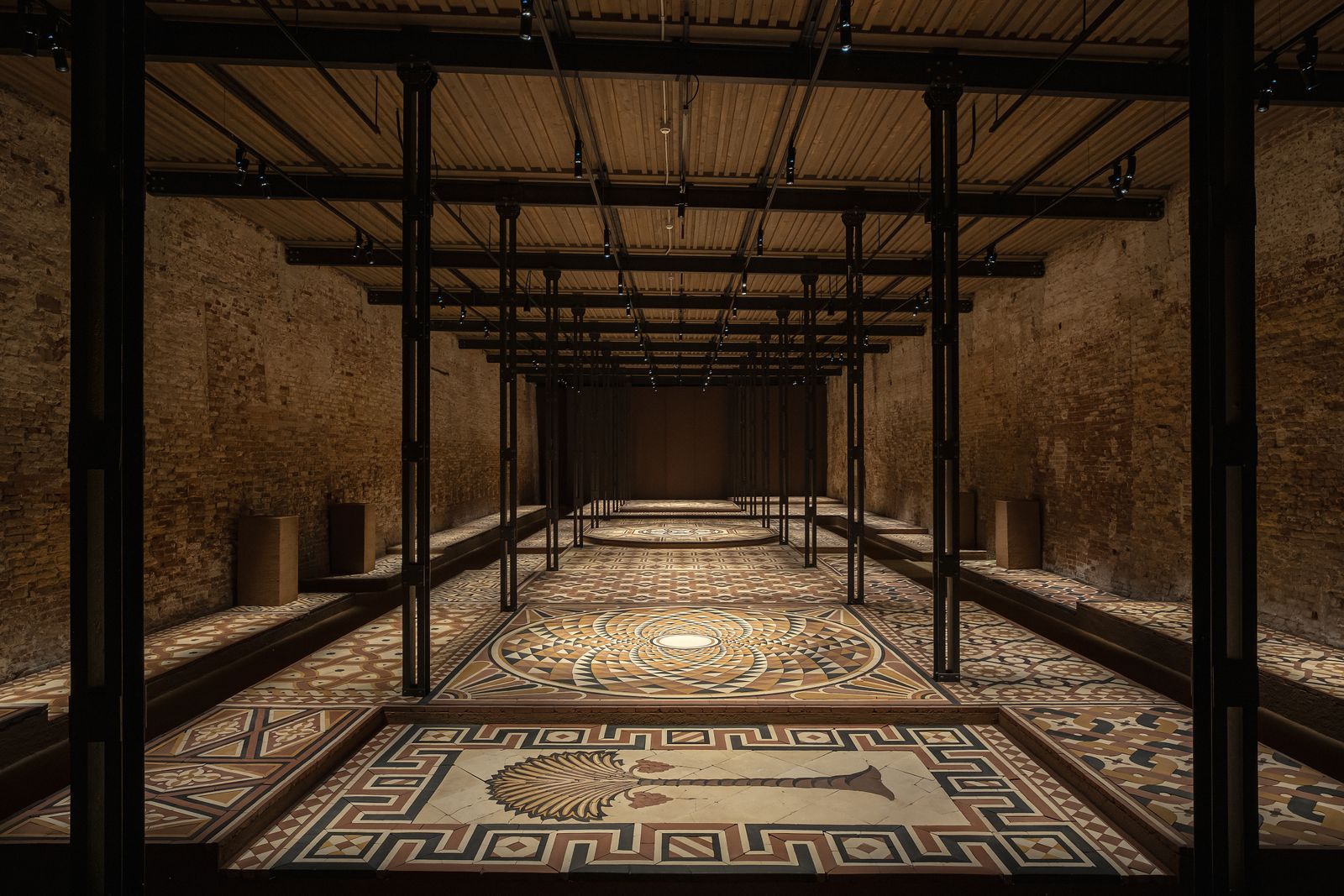
The Saudi pavilion is easily one of the most exciting across the ninety-nine country-specific presentations. In a year full of spectacle, nudity, edgy art-science-tech collaborations, and lots of excrement, Saudi Arabia’s pavilion proves that sometimes the most powerful artworks are the quietest – the ones that look back, using techniques and materials that date thousands of years. Starring Dana Awartani and curated by Antonia Carver, the installation lays it all out on the floor in a monumental mosaic of nearly 30,000 Earthen clay pieces featuring motifs taken from endangered historical sites from around the Arab world.
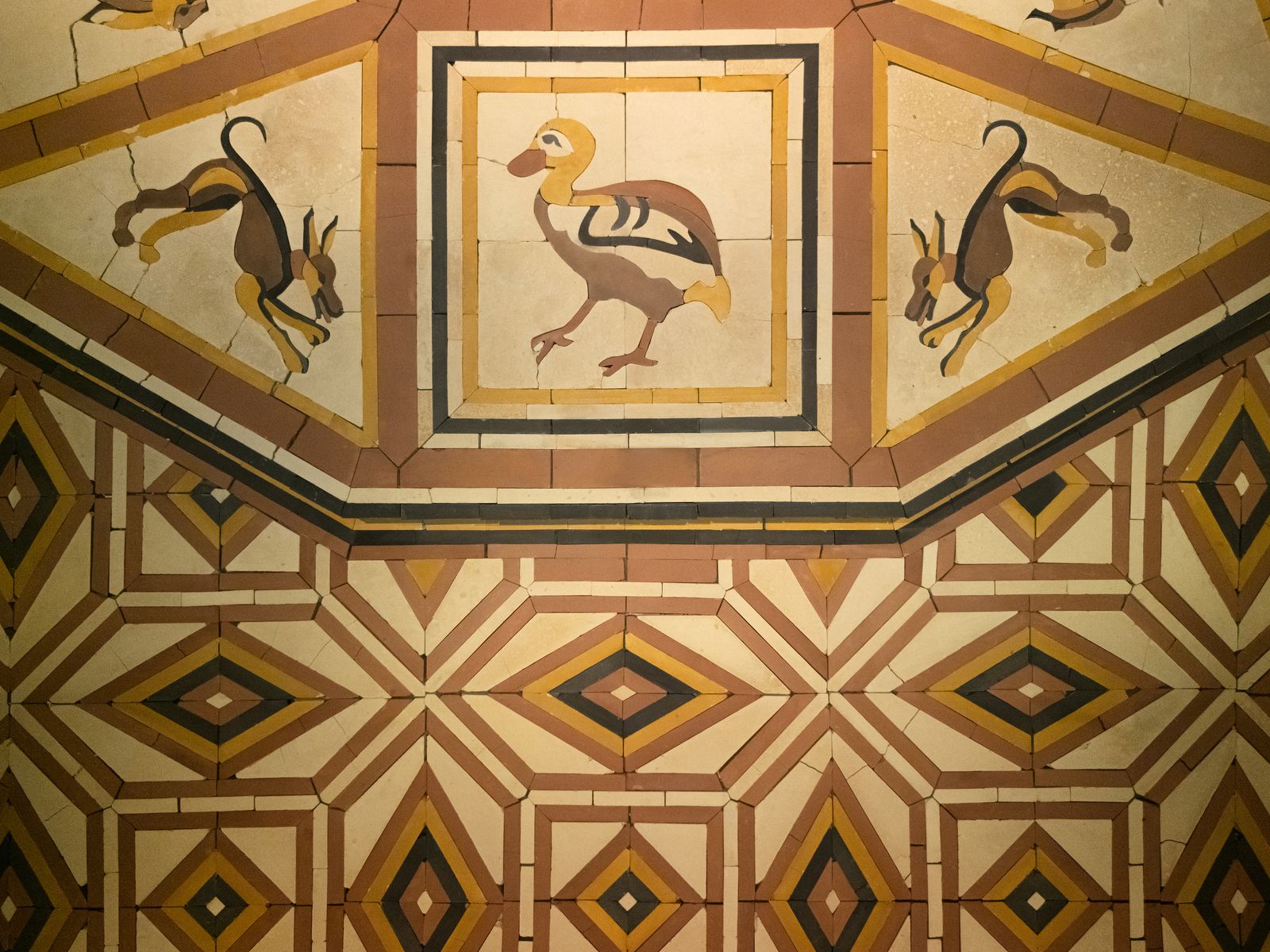
The work also presents a fascinating dialogue with Venice itself, which has had successive waves of fascination with Southwest Asian design, a fact mostly unattributed but visible in a lagoon city full of “Arabesque” latticework, tiled palazzo floors, and mashrabiya-filled window screens. The work commands a respectful reverence: despite the frenzy of the biennale preview days, the pavilion remained pin-drop quiet as the audience took the space in with awe. Alongside popular and masterful national presentations from India and Austria, Saudi Arabia would certainly be a contender for best pavilion. It’s a shame that no Golden Lions will be awarded this year.
Read more here: Saudi Pavilion at Venice Biennale Recreates 23 Destroyed Heritage Sites in a Monumental Floor Installation
Qatar Pavilion
%20at%20the%2061st%20International%20Art%20Exhibition%20%E2%80%93%20La%20Biennale%20di%20Venezia.%20.jpeg)
This is Qatar’s first national pavilion in Venice – and in a true power move, the country has secured a permanent spot in the Giardini, a near-impossibility. For the exhibition entitled “untitled 2026 (a gathering of remarkable people),” Qatar built a temporary auburn-tiled open-air majlis on the site of their future pavilion in a presentation that centres the spirit of Arab hospitality, conviviality, and vibes. The artist selection signals a strong East-East dialogue between Southwest and East Asia, while also showcasing newly minted blue-chip Khaleeji artists Sophia Al-Maria and Alia Farid.
%2520by%2520alia%2520farid%2520within%2520untitled%25202026%2520(a%2520gathering%2520of%2520remarkable%2520people)..jpg)
.jpg)
One of Farid’s monuments stands sentinel at the entrance, while Tarek Atoui convenes a series of music performances featuring Naghib Shanbehzadeh and others. For the exhibition’s first ten days, two Qatari dishes are available to try in a menu designed by Fadi Kattan, a well-worn conceit from Tiravanija’s “relational aesthetic” toolkit, who solidified his place in art history books by cooking Thai food in the 90s NY art scene. This is part two of Tiravanija’s Qatar series, after a previous food performance at Art Basel Qatar and a future one at Rubaiya Qatar, the country’s upcoming quadrennial (a biennial occurring every 4 years). And judging by the huge smiles on the visitors’ faces, the whole affair was a huge success. I smiled, too.
UAE Pavilion
.%20Image%20courtesy%20of%20National-Pavilion%20UAE%20%E2%80%93%20La%20Biennale%20di%20Venezia.%20Photo%20by%20Ismail%20Noor%20of%C2%A0Seeing%C2%A0Things-7090.jpg)
The Salama Foundation, which commissions the UAE pavilion, has celebrated huge successes in recent years by winning the Golden Lion at the 2021 Venice Architecture Biennale and a visitor’s award at the Osaka Expo. This year, the pavilion offers up an understated presentation in keeping with the ethos and tenor of biennale curator Koyo Kuouh’s theme “In Minor Keys.” The exhibition is called “Washwasha” – Arabic for “whispers.”

Highlights include an immersive sound art installation from Taus Makhacheva and Mays Albaik’s cast glass vessels of her own mouth. Of special interest is a compact installation by Emirati artist Alaa Edris, featuring a darkened room with three wooden faces whose eyes hauntingly dart back and forth at the viewer.

Also read: The Arab World and South Asia at Venice Biennale 2026, 12 Pavilions and Exhibitions You Can’t Miss
The 2026 Venice Art Biennale runs until November 22, 2026.


